Biography
Gustave Courbet was born in 1819 in Ornans, a small town in the Jura region of eastern France, the son of a prosperous farmer. He arrived in Paris in 1840 and was largely self-taught, copying in the Louvre, and in his early years he painted a number of romantic self-portraits.
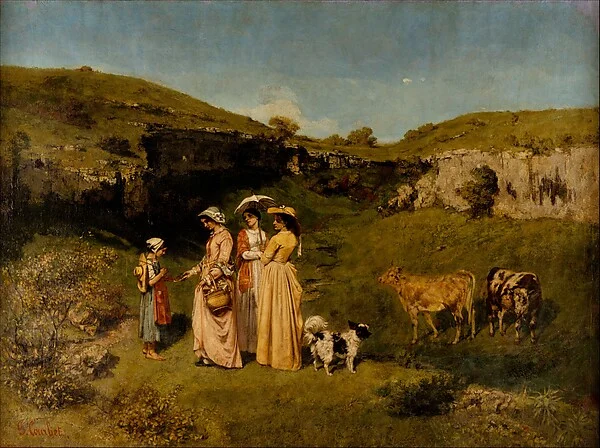
A Burial at Ornans, of 1849 to 1850, depicted the funeral of ordinary people from his hometown on a vast scale previously reserved for history painting and caused an uproar. Declaring that he would paint only what the eye could see, Courbet became the standard-bearer of Realism. When some of his works were rejected by the Paris Exposition Universelle of 1855, he built his own Pavilion of Realism nearby to show them. Young Ladies of the Village, depicting his three sisters giving alms to a cowherd girl in a valley near home, was also criticized at the Salon, while Woman with a Parrot, a daring nude, challenged the idealized nude of tradition.
Politically a republican with socialist sympathies, Courbet took part in the Paris Commune of 1871 and was afterward held responsible for the toppling of the Vendôme Column, imprisoned and ordered to pay enormous damages. In 1873 he fled to Switzerland, and he died in 1877 at La Tour-de-Peilz on Lake Geneva. His Realism opened the way for Édouard Manet and the Impressionists.